Leveraging Uncertainty in Collective Opinion Dynamics
2024 / Berlin, Germany, SCIoI
Network Science, Bayesian, Complex Systems, Python
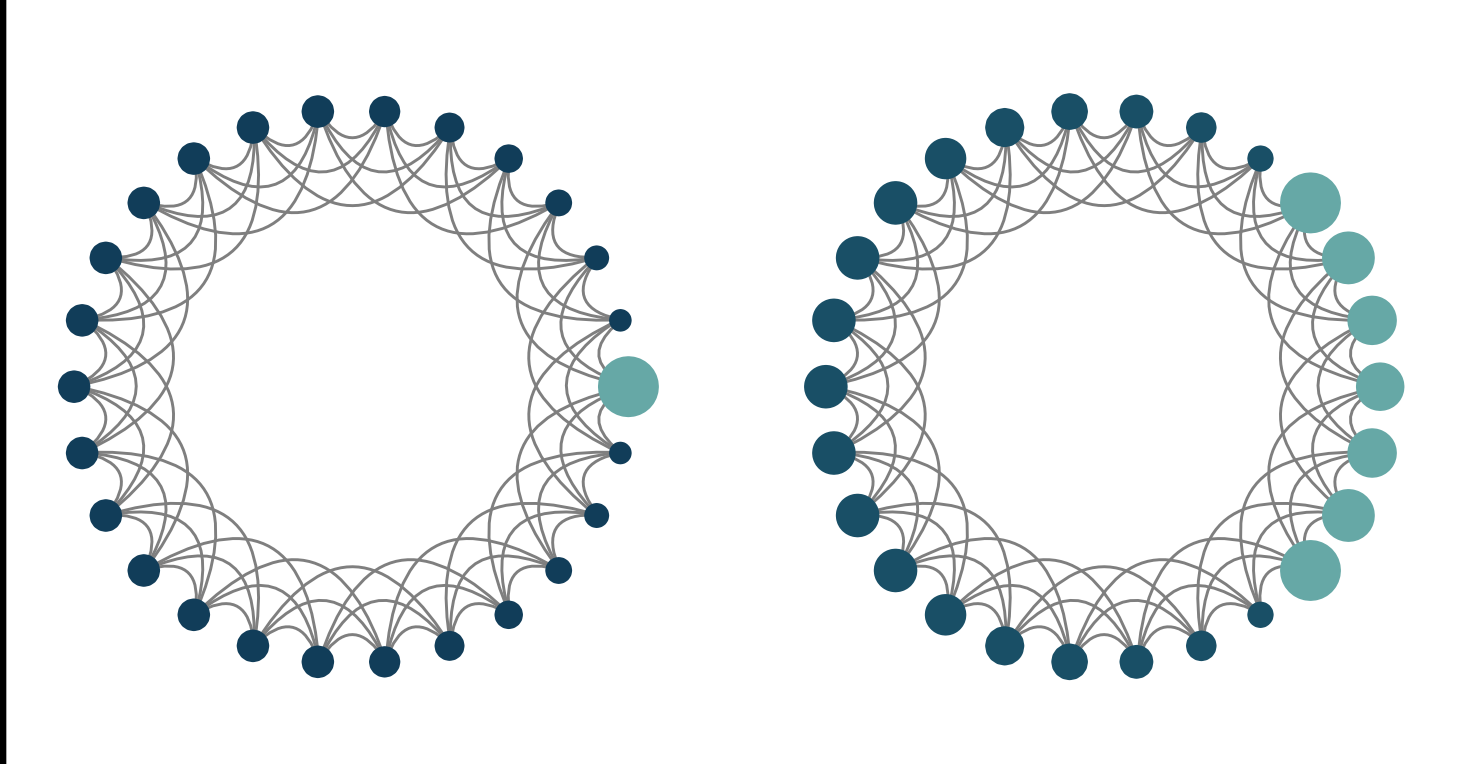
A Bayesian model of opinion dynamics in which agents represent beliefs as Gaussian distributions and continuously reweigh social influence against their own uncertainty, rather than relying on fixed trust weights. Published in Scientific Reports (Nature), the work shows how network centrality and information quality jointly determine how fast, and how accurately, a group converges on consensus.
// research summary
Traditional models like the DeGroot model assume static influence weights. This research, published in Scientific Reports, replaces static weights with a Bayesian update rule: agents maintain both an opinion (mean) and an uncertainty (variance), and adaptively weigh neighbors accordingly. Agents naturally trust more confident neighbors, leading to faster and more accurate consensus in complex environments.
Figure above: evolution of collective uncertainty on scale-free vs. random networks.
Dual Heterogeneity
We investigate the interplay between topological heterogeneity (degree centrality in scale-free networks) and epistemic heterogeneity (varying quality of initial information).
Uncertainty as a Signal
Uncertainty isn’t just a parameter; it’s an observable dimension. Agents use it to gauge the reliability of information, letting the network filter out noise without global supervision.
key insight
The research identifies the “overconfidence trap”: consensus accuracy collapses when highly central nodes (hubs) hold high confidence but low information quality. For a collective to be “wise,” social influence (centrality) must be positively correlated with information certainty.
// research stack