TrustMyETA: Routing ETA Uncertainty Quantification
2025 / Berlin, Germany
Monte Carlo Sim, Geospatial Analysis, React, TypeScript
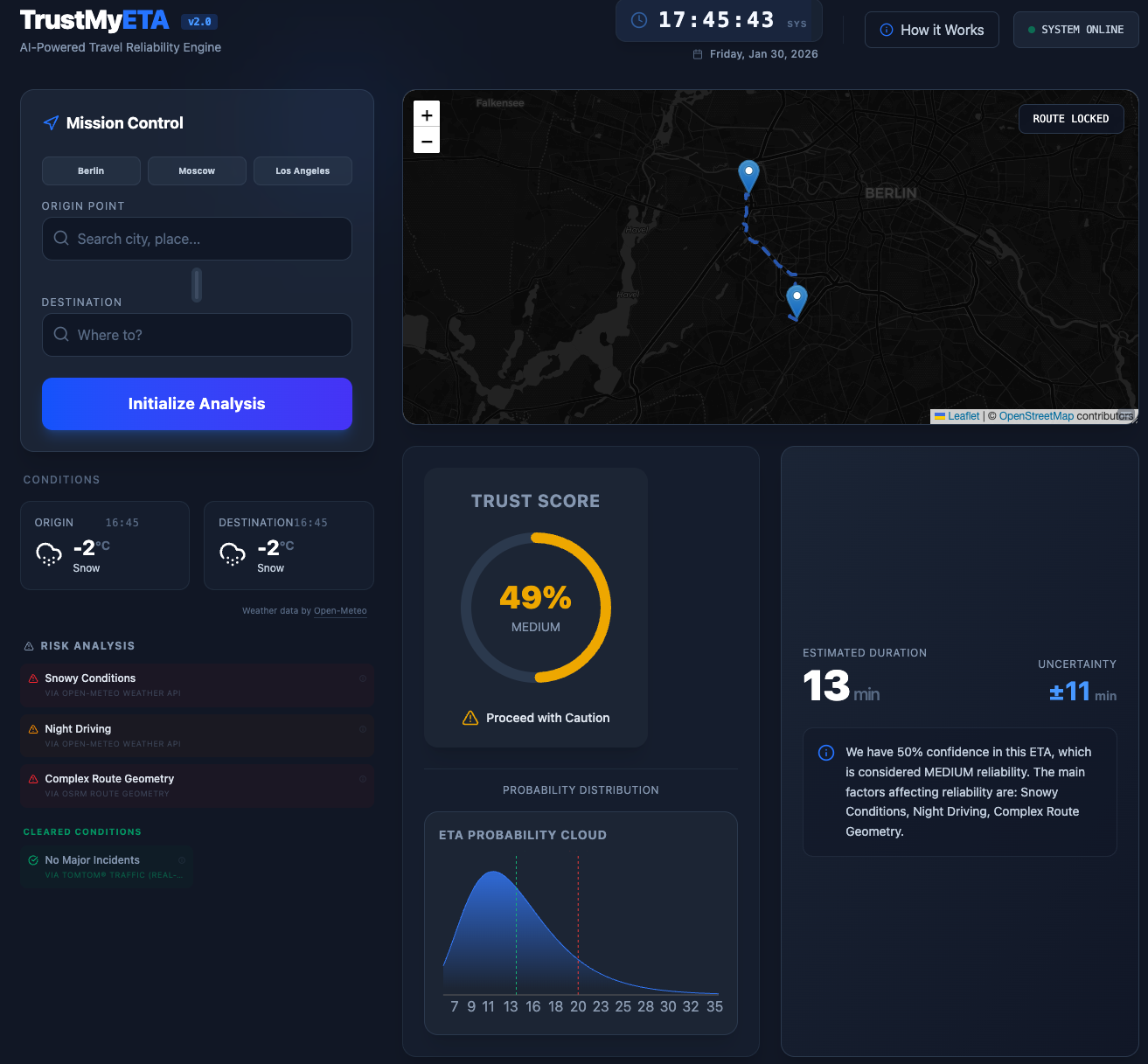
A route-planning prototype that predicts arrival times as a probability range instead of a single number. Each route gets a Trust Score, computed from weather, traffic, incident data, and route geometry, to make clear how reliable the estimate actually is.
// functional summary
TrustMyETA is a travel-time prediction system that calculates a Trust Score for any given route. Instead of a single ETA, it returns a probabilistic arrival-time range based on risk factors.
Figure above: dashboard view, risk analysis and trust score.
Core Logic
Uses Monte Carlo simulation (1000 iterations) to model travel variability.
Input Vectors
Analyzes route geometry (tortuosity), real-time weather (snow, visibility), and traffic patterns.
output
A normalized reliability score (0–100%), P95 worst-case arrival time, and categorized risk factors (safe / caution / high).
// system architecture
// technical stack & skills
The project demonstrates proficiency in modern frontend engineering, geospatial analysis, and system architecture.
Backend & data science concepts
// technical challenge
One of the detailed challenges was efficiently running 1000+ Monte Carlo iterations in real-time on the client side without blocking the main thread, solved by optimizing the statistical modeling algorithms in TypeScript.
// key features
Probabilistic Estimation
Uses Monte Carlo simulations (1000 iter.) to go beyond single-point estimates, providing full probability distributions for arrival times.
Confidence Metrics
Calculates a unique 'Trust Score' (normalized 0-100%) and P95 worst-case scenarios to help users make safer travel decisions.
Multi-Input Analysis
Synthesizes route tortuosity, real-time weather data (snow/visibility), and historic traffic patterns into a single reliability metric.