The abstract base class for layouts. More...
Public Member Functions | |
| QCPLayout () | |
| virtual void | update (UpdatePhase phase) Q_DECL_OVERRIDE |
| virtual QList< QCPLayoutElement * > | elements (bool recursive) const Q_DECL_OVERRIDE |
| virtual int | elementCount () const =0 |
| virtual QCPLayoutElement * | elementAt (int index) const =0 |
| virtual QCPLayoutElement * | takeAt (int index)=0 |
| virtual bool | take (QCPLayoutElement *element)=0 |
| virtual void | simplify () |
| bool | removeAt (int index) |
| bool | remove (QCPLayoutElement *element) |
| void | clear () |
| Public Member Functions inherited from QCPLayoutElement | |
| QCPLayoutElement (QCustomPlot *parentPlot=nullptr) | |
| QCPLayout * | layout () const |
| QRect | rect () const |
| QRect | outerRect () const |
| QMargins | margins () const |
| QMargins | minimumMargins () const |
| QCP::MarginSides | autoMargins () const |
| QSize | minimumSize () const |
| QSize | maximumSize () const |
| SizeConstraintRect | sizeConstraintRect () const |
| QCPMarginGroup * | marginGroup (QCP::MarginSide side) const |
| QHash< QCP::MarginSide, QCPMarginGroup * > | marginGroups () const |
| void | setOuterRect (const QRect &rect) |
| void | setMargins (const QMargins &margins) |
| void | setMinimumMargins (const QMargins &margins) |
| void | setAutoMargins (QCP::MarginSides sides) |
| void | setMinimumSize (const QSize &size) |
| void | setMinimumSize (int width, int height) |
| void | setMaximumSize (const QSize &size) |
| void | setMaximumSize (int width, int height) |
| void | setSizeConstraintRect (SizeConstraintRect constraintRect) |
| void | setMarginGroup (QCP::MarginSides sides, QCPMarginGroup *group) |
| virtual QSize | minimumOuterSizeHint () const |
| virtual QSize | maximumOuterSizeHint () const |
| virtual double | selectTest (const QPointF &pos, bool onlySelectable, QVariant *details=nullptr) const Q_DECL_OVERRIDE |
| Public Member Functions inherited from QCPLayerable | |
| QCPLayerable (QCustomPlot *plot, QString targetLayer=QString(), QCPLayerable *parentLayerable=nullptr) | |
| bool | visible () const |
| QCustomPlot * | parentPlot () const |
| QCPLayerable * | parentLayerable () const |
| QCPLayer * | layer () const |
| bool | antialiased () const |
| void | setVisible (bool on) |
| Q_SLOT bool | setLayer (QCPLayer *layer) |
| bool | setLayer (const QString &layerName) |
| void | setAntialiased (bool enabled) |
| bool | realVisibility () const |
Protected Member Functions | |
| virtual void | updateLayout () |
| void | sizeConstraintsChanged () const |
| void | adoptElement (QCPLayoutElement *el) |
| void | releaseElement (QCPLayoutElement *el) |
| QVector< int > | getSectionSizes (QVector< int > maxSizes, QVector< int > minSizes, QVector< double > stretchFactors, int totalSize) const |
| Protected Member Functions inherited from QCPLayoutElement | |
| virtual int | calculateAutoMargin (QCP::MarginSide side) |
| virtual void | layoutChanged () |
| virtual void | applyDefaultAntialiasingHint (QCPPainter *painter) const Q_DECL_OVERRIDE |
| virtual void | draw (QCPPainter *painter) Q_DECL_OVERRIDE |
| virtual void | parentPlotInitialized (QCustomPlot *parentPlot) Q_DECL_OVERRIDE |
| Protected Member Functions inherited from QCPLayerable | |
| virtual QCP::Interaction | selectionCategory () const |
| virtual QRect | clipRect () const |
| virtual void | selectEvent (QMouseEvent *event, bool additive, const QVariant &details, bool *selectionStateChanged) |
| virtual void | deselectEvent (bool *selectionStateChanged) |
| virtual void | mousePressEvent (QMouseEvent *event, const QVariant &details) |
| virtual void | mouseMoveEvent (QMouseEvent *event, const QPointF &startPos) |
| virtual void | mouseReleaseEvent (QMouseEvent *event, const QPointF &startPos) |
| virtual void | mouseDoubleClickEvent (QMouseEvent *event, const QVariant &details) |
| virtual void | wheelEvent (QWheelEvent *event) |
| void | initializeParentPlot (QCustomPlot *parentPlot) |
| void | setParentLayerable (QCPLayerable *parentLayerable) |
| bool | moveToLayer (QCPLayer *layer, bool prepend) |
| void | applyAntialiasingHint (QCPPainter *painter, bool localAntialiased, QCP::AntialiasedElement overrideElement) const |
Static Protected Member Functions | |
| static QSize | getFinalMinimumOuterSize (const QCPLayoutElement *el) |
| static QSize | getFinalMaximumOuterSize (const QCPLayoutElement *el) |
Friends | |
| class | QCPLayoutElement |
Additional Inherited Members | |
| Public Types inherited from QCPLayoutElement | |
| enum | UpdatePhase { upPreparation , upMargins , upLayout } |
| enum | SizeConstraintRect { scrInnerRect , scrOuterRect } |
| Signals inherited from QCPLayerable | |
| void | layerChanged (QCPLayer *newLayer) |
| Protected Attributes inherited from QCPLayoutElement | |
| QCPLayout * | mParentLayout |
| QSize | mMinimumSize |
| QSize | mMaximumSize |
| SizeConstraintRect | mSizeConstraintRect |
| QRect | mRect |
| QRect | mOuterRect |
| QMargins | mMargins |
| QMargins | mMinimumMargins |
| QCP::MarginSides | mAutoMargins |
| QHash< QCP::MarginSide, QCPMarginGroup * > | mMarginGroups |
| Protected Attributes inherited from QCPLayerable | |
| bool | mVisible |
| QCustomPlot * | mParentPlot |
| QPointer< QCPLayerable > | mParentLayerable |
| QCPLayer * | mLayer |
| bool | mAntialiased |
Detailed Description
The abstract base class for layouts.
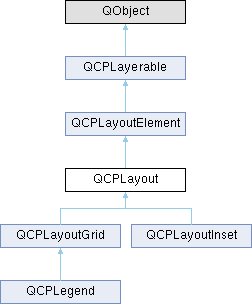
This is an abstract base class for layout elements whose main purpose is to define the position and size of other child layout elements. In most cases, layouts don't draw anything themselves (but there are exceptions to this, e.g. QCPLegend).
QCPLayout derives from QCPLayoutElement, and thus can itself be nested in other layouts.
QCPLayout introduces a common interface for accessing and manipulating the child elements. Those functions are most notably elementCount, elementAt, takeAt, take, simplify, removeAt, remove and clear. Individual subclasses may add more functions to this interface which are more specialized to the form of the layout. For example, QCPLayoutGrid adds functions that take row and column indices to access cells of the layout grid more conveniently.
Since this is an abstract base class, you can't instantiate it directly. Rather use one of its subclasses like QCPLayoutGrid or QCPLayoutInset.
For a general introduction to the layout system, see the dedicated documentation page The Layout System.
Constructor & Destructor Documentation
◆ QCPLayout()
|
explicit |
Member Function Documentation
◆ clear()
| void QCPLayout::clear | ( | ) |
◆ elementAt()
|
pure virtual |
Returns the element in the cell with the given index. If index is invalid, returns nullptr.
Note that even if index is valid, the respective cell may be empty in some layouts (e.g. QCPLayoutGrid), so this function may return nullptr in those cases. You may use this function to check whether a cell is empty or not.
- See also
- elements, elementCount, takeAt
Implemented in QCPLayoutGrid, and QCPLayoutInset.
◆ elementCount()
|
pure virtual |
Returns the number of elements/cells in the layout.
Implemented in QCPLayoutGrid, and QCPLayoutInset.
◆ elements()
|
virtual |
Returns a list of all child elements in this layout element. If recursive is true, all sub-child elements are included in the list, too.
- Warning
- There may be
nullptrentries in the returned list. For example, QCPLayoutGrid may have empty cells which yieldnullptrat the respective index.
Reimplemented from QCPLayoutElement.
Reimplemented in QCPLayoutGrid.
◆ remove()
| bool QCPLayout::remove | ( | QCPLayoutElement * | element | ) |
Removes and deletes the provided element. Returns true on success. If element is not in the layout, returns false.
This function internally uses takeAt to remove the element from the layout and then deletes the element. Note that some layouts don't remove the respective cell right away but leave an empty cell after successful removal of the layout element. To collapse empty cells, use simplify.
◆ removeAt()
| bool QCPLayout::removeAt | ( | int | index | ) |
Removes and deletes the element at the provided index. Returns true on success. If index is invalid or points to an empty cell, returns false.
This function internally uses takeAt to remove the element from the layout and then deletes the returned element. Note that some layouts don't remove the respective cell right away but leave an empty cell after successful removal of the layout element. To collapse empty cells, use simplify.
◆ simplify()
|
virtual |
Simplifies the layout by collapsing empty cells. The exact behavior depends on subclasses, the default implementation does nothing.
Not all layouts need simplification. For example, QCPLayoutInset doesn't use explicit simplification while QCPLayoutGrid does.
Reimplemented in QCPLayoutGrid, and QCPLayoutInset.
◆ sizeConstraintsChanged()
|
protected |
Subclasses call this method to report changed (minimum/maximum) size constraints.
If the parent of this layout is again a QCPLayout, forwards the call to the parent's sizeConstraintsChanged. If the parent is a QWidget (i.e. is the QCustomPlot::plotLayout of QCustomPlot), calls QWidget::updateGeometry, so if the QCustomPlot widget is inside a Qt QLayout, it may update itself and resize cells accordingly.
◆ take()
|
pure virtual |
Removes the specified element from the layout and returns true on success.
If the element isn't in this layout, returns false.
Note that some layouts don't remove the respective cell right away but leave an empty cell after successful removal of the layout element. To collapse empty cells, use simplify.
- See also
- takeAt
Implemented in QCPLayoutGrid, and QCPLayoutInset.
◆ takeAt()
|
pure virtual |
Removes the element with the given index from the layout and returns it.
If the index is invalid or the cell with that index is empty, returns nullptr.
Note that some layouts don't remove the respective cell right away but leave an empty cell after successful removal of the layout element. To collapse empty cells, use simplify.
Implemented in QCPLayoutGrid, and QCPLayoutInset.
◆ update()
|
virtual |
If phase is upLayout, calls updateLayout, which subclasses may reimplement to reposition and resize their cells.
Finally, the call is propagated down to all child QCPLayoutElements.
For details about this method and the update phases, see the documentation of QCPLayoutElement::update.
Reimplemented from QCPLayoutElement.
The documentation for this class was generated from the following files:
- qcustomplot.h
- qcustomplot.cpp