A plottable representing a parametric curve in a plot. More...
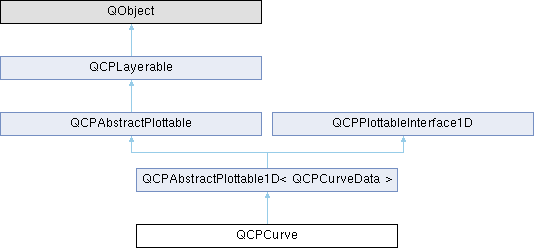
Public Types | |
| enum | LineStyle { lsNone , lsLine } |
Public Member Functions | |
| QCPCurve (QCPAxis *keyAxis, QCPAxis *valueAxis) | |
| QSharedPointer< QCPCurveDataContainer > | data () const |
| QCPScatterStyle | scatterStyle () const |
| int | scatterSkip () const |
| LineStyle | lineStyle () const |
| void | setData (QSharedPointer< QCPCurveDataContainer > data) |
| void | setData (const QVector< double > &t, const QVector< double > &keys, const QVector< double > &values, bool alreadySorted=false) |
| void | setData (const QVector< double > &keys, const QVector< double > &values) |
| void | setScatterStyle (const QCPScatterStyle &style) |
| void | setScatterSkip (int skip) |
| void | setLineStyle (LineStyle style) |
| void | addData (const QVector< double > &t, const QVector< double > &keys, const QVector< double > &values, bool alreadySorted=false) |
| void | addData (const QVector< double > &keys, const QVector< double > &values) |
| void | addData (double t, double key, double value) |
| void | addData (double key, double value) |
| virtual double | selectTest (const QPointF &pos, bool onlySelectable, QVariant *details=nullptr) const Q_DECL_OVERRIDE |
| virtual QCPRange | getKeyRange (bool &foundRange, QCP::SignDomain inSignDomain=QCP::sdBoth) const Q_DECL_OVERRIDE |
| virtual QCPRange | getValueRange (bool &foundRange, QCP::SignDomain inSignDomain=QCP::sdBoth, const QCPRange &inKeyRange=QCPRange()) const Q_DECL_OVERRIDE |
| Public Member Functions inherited from QCPAbstractPlottable1D< QCPCurveData > | |
| QCPAbstractPlottable1D (QCPAxis *keyAxis, QCPAxis *valueAxis) | |
| virtual int | dataCount () const Q_DECL_OVERRIDE |
| virtual double | dataMainKey (int index) const Q_DECL_OVERRIDE |
| virtual double | dataSortKey (int index) const Q_DECL_OVERRIDE |
| virtual double | dataMainValue (int index) const Q_DECL_OVERRIDE |
| virtual QCPRange | dataValueRange (int index) const Q_DECL_OVERRIDE |
| virtual QPointF | dataPixelPosition (int index) const Q_DECL_OVERRIDE |
| virtual bool | sortKeyIsMainKey () const Q_DECL_OVERRIDE |
| virtual QCPDataSelection | selectTestRect (const QRectF &rect, bool onlySelectable) const Q_DECL_OVERRIDE |
| virtual int | findBegin (double sortKey, bool expandedRange=true) const Q_DECL_OVERRIDE |
| virtual int | findEnd (double sortKey, bool expandedRange=true) const Q_DECL_OVERRIDE |
| virtual QCPPlottableInterface1D * | interface1D () Q_DECL_OVERRIDE |
| Public Member Functions inherited from QCPAbstractPlottable | |
| QCPAbstractPlottable (QCPAxis *keyAxis, QCPAxis *valueAxis) | |
| QString | name () const |
| bool | antialiasedFill () const |
| bool | antialiasedScatters () const |
| QPen | pen () const |
| QBrush | brush () const |
| QCPAxis * | keyAxis () const |
| QCPAxis * | valueAxis () const |
| QCP::SelectionType | selectable () const |
| bool | selected () const |
| QCPDataSelection | selection () const |
| QCPSelectionDecorator * | selectionDecorator () const |
| void | setName (const QString &name) |
| void | setAntialiasedFill (bool enabled) |
| void | setAntialiasedScatters (bool enabled) |
| void | setPen (const QPen &pen) |
| void | setBrush (const QBrush &brush) |
| void | setKeyAxis (QCPAxis *axis) |
| void | setValueAxis (QCPAxis *axis) |
| Q_SLOT void | setSelectable (QCP::SelectionType selectable) |
| Q_SLOT void | setSelection (QCPDataSelection selection) |
| void | setSelectionDecorator (QCPSelectionDecorator *decorator) |
| void | coordsToPixels (double key, double value, double &x, double &y) const |
| const QPointF | coordsToPixels (double key, double value) const |
| void | pixelsToCoords (double x, double y, double &key, double &value) const |
| void | pixelsToCoords (const QPointF &pixelPos, double &key, double &value) const |
| void | rescaleAxes (bool onlyEnlarge=false) const |
| void | rescaleKeyAxis (bool onlyEnlarge=false) const |
| void | rescaleValueAxis (bool onlyEnlarge=false, bool inKeyRange=false) const |
| bool | addToLegend (QCPLegend *legend) |
| bool | addToLegend () |
| bool | removeFromLegend (QCPLegend *legend) const |
| bool | removeFromLegend () const |
| Public Member Functions inherited from QCPLayerable | |
| QCPLayerable (QCustomPlot *plot, QString targetLayer=QString(), QCPLayerable *parentLayerable=nullptr) | |
| bool | visible () const |
| QCustomPlot * | parentPlot () const |
| QCPLayerable * | parentLayerable () const |
| QCPLayer * | layer () const |
| bool | antialiased () const |
| void | setVisible (bool on) |
| Q_SLOT bool | setLayer (QCPLayer *layer) |
| bool | setLayer (const QString &layerName) |
| void | setAntialiased (bool enabled) |
| bool | realVisibility () const |
Protected Member Functions | |
| virtual void | draw (QCPPainter *painter) Q_DECL_OVERRIDE |
| virtual void | drawLegendIcon (QCPPainter *painter, const QRectF &rect) const Q_DECL_OVERRIDE |
| virtual void | drawCurveLine (QCPPainter *painter, const QVector< QPointF > &lines) const |
| virtual void | drawScatterPlot (QCPPainter *painter, const QVector< QPointF > &points, const QCPScatterStyle &style) const |
| void | getCurveLines (QVector< QPointF > *lines, const QCPDataRange &dataRange, double penWidth) const |
| void | getScatters (QVector< QPointF > *scatters, const QCPDataRange &dataRange, double scatterWidth) const |
| int | getRegion (double key, double value, double keyMin, double valueMax, double keyMax, double valueMin) const |
| QPointF | getOptimizedPoint (int otherRegion, double otherKey, double otherValue, double key, double value, double keyMin, double valueMax, double keyMax, double valueMin) const |
| QVector< QPointF > | getOptimizedCornerPoints (int prevRegion, int currentRegion, double prevKey, double prevValue, double key, double value, double keyMin, double valueMax, double keyMax, double valueMin) const |
| bool | mayTraverse (int prevRegion, int currentRegion) const |
| bool | getTraverse (double prevKey, double prevValue, double key, double value, double keyMin, double valueMax, double keyMax, double valueMin, QPointF &crossA, QPointF &crossB) const |
| void | getTraverseCornerPoints (int prevRegion, int currentRegion, double keyMin, double valueMax, double keyMax, double valueMin, QVector< QPointF > &beforeTraverse, QVector< QPointF > &afterTraverse) const |
| double | pointDistance (const QPointF &pixelPoint, QCPCurveDataContainer::const_iterator &closestData) const |
| Protected Member Functions inherited from QCPAbstractPlottable1D< QCPCurveData > | |
| void | getDataSegments (QList< QCPDataRange > &selectedSegments, QList< QCPDataRange > &unselectedSegments) const |
| void | drawPolyline (QCPPainter *painter, const QVector< QPointF > &lineData) const |
| Protected Member Functions inherited from QCPAbstractPlottable | |
| virtual QRect | clipRect () const Q_DECL_OVERRIDE |
| virtual QCP::Interaction | selectionCategory () const Q_DECL_OVERRIDE |
| void | applyDefaultAntialiasingHint (QCPPainter *painter) const Q_DECL_OVERRIDE |
| virtual void | selectEvent (QMouseEvent *event, bool additive, const QVariant &details, bool *selectionStateChanged) Q_DECL_OVERRIDE |
| virtual void | deselectEvent (bool *selectionStateChanged) Q_DECL_OVERRIDE |
| void | applyFillAntialiasingHint (QCPPainter *painter) const |
| void | applyScattersAntialiasingHint (QCPPainter *painter) const |
| Protected Member Functions inherited from QCPLayerable | |
| virtual void | parentPlotInitialized (QCustomPlot *parentPlot) |
| virtual void | mousePressEvent (QMouseEvent *event, const QVariant &details) |
| virtual void | mouseMoveEvent (QMouseEvent *event, const QPointF &startPos) |
| virtual void | mouseReleaseEvent (QMouseEvent *event, const QPointF &startPos) |
| virtual void | mouseDoubleClickEvent (QMouseEvent *event, const QVariant &details) |
| virtual void | wheelEvent (QWheelEvent *event) |
| void | initializeParentPlot (QCustomPlot *parentPlot) |
| void | setParentLayerable (QCPLayerable *parentLayerable) |
| bool | moveToLayer (QCPLayer *layer, bool prepend) |
| void | applyAntialiasingHint (QCPPainter *painter, bool localAntialiased, QCP::AntialiasedElement overrideElement) const |
Protected Attributes | |
| QCPScatterStyle | mScatterStyle |
| int | mScatterSkip |
| LineStyle | mLineStyle |
| Protected Attributes inherited from QCPAbstractPlottable1D< QCPCurveData > | |
| QSharedPointer< QCPDataContainer< QCPCurveData > > | mDataContainer |
| Protected Attributes inherited from QCPAbstractPlottable | |
| QString | mName |
| bool | mAntialiasedFill |
| bool | mAntialiasedScatters |
| QPen | mPen |
| QBrush | mBrush |
| QPointer< QCPAxis > | mKeyAxis |
| QPointer< QCPAxis > | mValueAxis |
| QCP::SelectionType | mSelectable |
| QCPDataSelection | mSelection |
| QCPSelectionDecorator * | mSelectionDecorator |
| Protected Attributes inherited from QCPLayerable | |
| bool | mVisible |
| QCustomPlot * | mParentPlot |
| QPointer< QCPLayerable > | mParentLayerable |
| QCPLayer * | mLayer |
| bool | mAntialiased |
Friends | |
| class | QCustomPlot |
| class | QCPLegend |
Additional Inherited Members | |
| Signals inherited from QCPAbstractPlottable | |
| void | selectionChanged (bool selected) |
| void | selectionChanged (const QCPDataSelection &selection) |
| void | selectableChanged (QCP::SelectionType selectable) |
| Signals inherited from QCPLayerable | |
| void | layerChanged (QCPLayer *newLayer) |
Detailed Description
A plottable representing a parametric curve in a plot.

Unlike QCPGraph, plottables of this type may have multiple points with the same key coordinate, so their visual representation can have loops. This is realized by introducing a third coordinate t, which defines the order of the points described by the other two coordinates x and y.
To plot data, assign it with the setData or addData functions. Alternatively, you can also access and modify the curve's data via the data method, which returns a pointer to the internal QCPCurveDataContainer.
Gaps in the curve can be created by adding data points with NaN as key and value (qQNaN() or std::numeric_limits<double>::quiet_NaN()) in between the two data points that shall be separated.
Changing the appearance
The appearance of the curve is determined by the pen and the brush (setPen, setBrush).
Usage
Like all data representing objects in QCustomPlot, the QCPCurve is a plottable (QCPAbstractPlottable). So the plottable-interface of QCustomPlot applies (QCustomPlot::plottable, QCustomPlot::removePlottable, etc.)
Usually, you first create an instance:
which registers it with the QCustomPlot instance of the passed axes. Note that this QCustomPlot instance takes ownership of the plottable, so do not delete it manually but use QCustomPlot::removePlottable() instead. The newly created plottable can be modified, e.g.:
Member Enumeration Documentation
◆ LineStyle
| enum QCPCurve::LineStyle |
Defines how the curve's line is represented visually in the plot. The line is drawn with the current pen of the curve (setPen).
- See also
- setLineStyle
| Enumerator | |
|---|---|
| lsNone | No line is drawn between data points (e.g. only scatters) |
| lsLine | Data points are connected with a straight line. |
Constructor & Destructor Documentation
◆ QCPCurve()
Constructs a curve which uses keyAxis as its key axis ("x") and valueAxis as its value axis ("y"). keyAxis and valueAxis must reside in the same QCustomPlot instance and not have the same orientation. If either of these restrictions is violated, a corresponding message is printed to the debug output (qDebug), the construction is not aborted, though.
The created QCPCurve is automatically registered with the QCustomPlot instance inferred from keyAxis. This QCustomPlot instance takes ownership of the QCPCurve, so do not delete it manually but use QCustomPlot::removePlottable() instead.
Member Function Documentation
◆ addData() [1/4]
| void QCPCurve::addData | ( | const QVector< double > & | keys, |
| const QVector< double > & | values ) |
This is an overloaded member function, provided for convenience. It differs from the above function only in what argument(s) it accepts.
Adds the provided points in keys and values to the current data. The provided vectors should have equal length. Else, the number of added points will be the size of the smallest vector.
The t parameter of each data point will be set to the integer index of the respective key/value pair.
Alternatively, you can also access and modify the data directly via the data method, which returns a pointer to the internal data container.
◆ addData() [2/4]
| void QCPCurve::addData | ( | const QVector< double > & | t, |
| const QVector< double > & | keys, | ||
| const QVector< double > & | values, | ||
| bool | alreadySorted = false ) |
This is an overloaded member function, provided for convenience. It differs from the above function only in what argument(s) it accepts.
Adds the provided points in t, keys and values to the current data. The provided vectors should have equal length. Else, the number of added points will be the size of the smallest vector.
If you can guarantee that the passed data points are sorted by keys in ascending order, you can set alreadySorted to true, to improve performance by saving a sorting run.
Alternatively, you can also access and modify the data directly via the data method, which returns a pointer to the internal data container.
◆ addData() [3/4]
| void QCPCurve::addData | ( | double | key, |
| double | value ) |
This is an overloaded member function, provided for convenience. It differs from the above function only in what argument(s) it accepts.
Adds the provided data point as key and value to the current data.
The t parameter is generated automatically by increments of 1 for each point, starting at the highest t of previously existing data or 0, if the curve data is empty.
Alternatively, you can also access and modify the data directly via the data method, which returns a pointer to the internal data container.
◆ addData() [4/4]
| void QCPCurve::addData | ( | double | t, |
| double | key, | ||
| double | value ) |
This is an overloaded member function, provided for convenience. It differs from the above function only in what argument(s) it accepts. Adds the provided data point as t, key and value to the current data.
Alternatively, you can also access and modify the data directly via the data method, which returns a pointer to the internal data container.
◆ data()
|
inline |
◆ draw()
|
protectedvirtual |
Implements QCPAbstractPlottable.
◆ drawLegendIcon()
|
protectedvirtual |
Implements QCPAbstractPlottable.
◆ getKeyRange()
|
virtual |
Returns the coordinate range that all data in this plottable span in the key axis dimension. For logarithmic plots, one can set inSignDomain to either QCP::sdNegative or QCP::sdPositive in order to restrict the returned range to that sign domain. E.g. when only negative range is wanted, set inSignDomain to QCP::sdNegative and all positive points will be ignored for range calculation. For no restriction, just set inSignDomain to QCP::sdBoth (default). foundRange is an output parameter that indicates whether a range could be found or not. If this is false, you shouldn't use the returned range (e.g. no points in data).
Note that foundRange is not the same as QCPRange::validRange, since the range returned by this function may have size zero (e.g. when there is only one data point). In this case foundRange would return true, but the returned range is not a valid range in terms of QCPRange::validRange.
- See also
- rescaleAxes, getValueRange
Implements QCPAbstractPlottable.
◆ getValueRange()
|
virtual |
Returns the coordinate range that the data points in the specified key range (inKeyRange) span in the value axis dimension. For logarithmic plots, one can set inSignDomain to either QCP::sdNegative or QCP::sdPositive in order to restrict the returned range to that sign domain. E.g. when only negative range is wanted, set inSignDomain to QCP::sdNegative and all positive points will be ignored for range calculation. For no restriction, just set inSignDomain to QCP::sdBoth (default). foundRange is an output parameter that indicates whether a range could be found or not. If this is false, you shouldn't use the returned range (e.g. no points in data).
If inKeyRange has both lower and upper bound set to zero (is equal to QCPRange()), all data points are considered, without any restriction on the keys.
Note that foundRange is not the same as QCPRange::validRange, since the range returned by this function may have size zero (e.g. when there is only one data point). In this case foundRange would return true, but the returned range is not a valid range in terms of QCPRange::validRange.
- See also
- rescaleAxes, getKeyRange
Implements QCPAbstractPlottable.
◆ selectTest()
|
virtual |
Implements a selectTest specific to this plottable's point geometry.
If details is not 0, it will be set to a QCPDataSelection, describing the closest data point to pos.
\seebaseclassmethod QCPAbstractPlottable::selectTest
Reimplemented from QCPAbstractPlottable1D< QCPCurveData >.
◆ setData() [1/3]
| void QCPCurve::setData | ( | const QVector< double > & | keys, |
| const QVector< double > & | values ) |
This is an overloaded member function, provided for convenience. It differs from the above function only in what argument(s) it accepts.
Replaces the current data with the provided points in keys and values. The provided vectors should have equal length. Else, the number of added points will be the size of the smallest vector.
The t parameter of each data point will be set to the integer index of the respective key/value pair.
- See also
- addData
◆ setData() [2/3]
| void QCPCurve::setData | ( | const QVector< double > & | t, |
| const QVector< double > & | keys, | ||
| const QVector< double > & | values, | ||
| bool | alreadySorted = false ) |
This is an overloaded member function, provided for convenience. It differs from the above function only in what argument(s) it accepts.
Replaces the current data with the provided points in t, keys and values. The provided vectors should have equal length. Else, the number of added points will be the size of the smallest vector.
If you can guarantee that the passed data points are sorted by t in ascending order, you can set alreadySorted to true, to improve performance by saving a sorting run.
- See also
- addData
◆ setData() [3/3]
| void QCPCurve::setData | ( | QSharedPointer< QCPCurveDataContainer > | data | ) |
This is an overloaded member function, provided for convenience. It differs from the above function only in what argument(s) it accepts.
Replaces the current data container with the provided data container.
Since a QSharedPointer is used, multiple QCPCurves may share the same data container safely. Modifying the data in the container will then affect all curves that share the container. Sharing can be achieved by simply exchanging the data containers wrapped in shared pointers:
If you do not wish to share containers, but create a copy from an existing container, rather use the QCPDataContainer<DataType>::set method on the curve's data container directly:
- See also
- addData
◆ setLineStyle()
| void QCPCurve::setLineStyle | ( | QCPCurve::LineStyle | style | ) |
Sets how the single data points are connected in the plot or how they are represented visually apart from the scatter symbol. For scatter-only plots, set style to lsNone and setScatterStyle to the desired scatter style.
- See also
- setScatterStyle
◆ setScatterSkip()
| void QCPCurve::setScatterSkip | ( | int | skip | ) |
If scatters are displayed (scatter style not QCPScatterStyle::ssNone), skip number of scatter points are skipped/not drawn after every drawn scatter point.
This can be used to make the data appear sparser while for example still having a smooth line, and to improve performance for very high density plots.
If skip is set to 0 (default), all scatter points are drawn.
- See also
- setScatterStyle
◆ setScatterStyle()
| void QCPCurve::setScatterStyle | ( | const QCPScatterStyle & | style | ) |
Sets the visual appearance of single data points in the plot. If set to QCPScatterStyle::ssNone, no scatter points are drawn (e.g. for line-only plots with appropriate line style).
- See also
- QCPScatterStyle, setLineStyle
The documentation for this class was generated from the following files:
- qcustomplot.h
- qcustomplot.cpp