A template base class for plottables with one-dimensional data. More...
#include <qcustomplot.h>
Public Member Functions | |
| QCPAbstractPlottable1D (QCPAxis *keyAxis, QCPAxis *valueAxis) | |
| virtual int | dataCount () const Q_DECL_OVERRIDE |
| virtual double | dataMainKey (int index) const Q_DECL_OVERRIDE |
| virtual double | dataSortKey (int index) const Q_DECL_OVERRIDE |
| virtual double | dataMainValue (int index) const Q_DECL_OVERRIDE |
| virtual QCPRange | dataValueRange (int index) const Q_DECL_OVERRIDE |
| virtual QPointF | dataPixelPosition (int index) const Q_DECL_OVERRIDE |
| virtual bool | sortKeyIsMainKey () const Q_DECL_OVERRIDE |
| virtual QCPDataSelection | selectTestRect (const QRectF &rect, bool onlySelectable) const Q_DECL_OVERRIDE |
| virtual int | findBegin (double sortKey, bool expandedRange=true) const Q_DECL_OVERRIDE |
| virtual int | findEnd (double sortKey, bool expandedRange=true) const Q_DECL_OVERRIDE |
| virtual double | selectTest (const QPointF &pos, bool onlySelectable, QVariant *details=nullptr) const Q_DECL_OVERRIDE |
| virtual QCPPlottableInterface1D * | interface1D () Q_DECL_OVERRIDE |
| Public Member Functions inherited from QCPAbstractPlottable | |
| QCPAbstractPlottable (QCPAxis *keyAxis, QCPAxis *valueAxis) | |
| QString | name () const |
| bool | antialiasedFill () const |
| bool | antialiasedScatters () const |
| QPen | pen () const |
| QBrush | brush () const |
| QCPAxis * | keyAxis () const |
| QCPAxis * | valueAxis () const |
| QCP::SelectionType | selectable () const |
| bool | selected () const |
| QCPDataSelection | selection () const |
| QCPSelectionDecorator * | selectionDecorator () const |
| void | setName (const QString &name) |
| void | setAntialiasedFill (bool enabled) |
| void | setAntialiasedScatters (bool enabled) |
| void | setPen (const QPen &pen) |
| void | setBrush (const QBrush &brush) |
| void | setKeyAxis (QCPAxis *axis) |
| void | setValueAxis (QCPAxis *axis) |
| Q_SLOT void | setSelectable (QCP::SelectionType selectable) |
| Q_SLOT void | setSelection (QCPDataSelection selection) |
| void | setSelectionDecorator (QCPSelectionDecorator *decorator) |
| virtual QCPRange | getKeyRange (bool &foundRange, QCP::SignDomain inSignDomain=QCP::sdBoth) const =0 |
| virtual QCPRange | getValueRange (bool &foundRange, QCP::SignDomain inSignDomain=QCP::sdBoth, const QCPRange &inKeyRange=QCPRange()) const =0 |
| void | coordsToPixels (double key, double value, double &x, double &y) const |
| const QPointF | coordsToPixels (double key, double value) const |
| void | pixelsToCoords (double x, double y, double &key, double &value) const |
| void | pixelsToCoords (const QPointF &pixelPos, double &key, double &value) const |
| void | rescaleAxes (bool onlyEnlarge=false) const |
| void | rescaleKeyAxis (bool onlyEnlarge=false) const |
| void | rescaleValueAxis (bool onlyEnlarge=false, bool inKeyRange=false) const |
| bool | addToLegend (QCPLegend *legend) |
| bool | addToLegend () |
| bool | removeFromLegend (QCPLegend *legend) const |
| bool | removeFromLegend () const |
| Public Member Functions inherited from QCPLayerable | |
| QCPLayerable (QCustomPlot *plot, QString targetLayer=QString(), QCPLayerable *parentLayerable=nullptr) | |
| bool | visible () const |
| QCustomPlot * | parentPlot () const |
| QCPLayerable * | parentLayerable () const |
| QCPLayer * | layer () const |
| bool | antialiased () const |
| void | setVisible (bool on) |
| Q_SLOT bool | setLayer (QCPLayer *layer) |
| bool | setLayer (const QString &layerName) |
| void | setAntialiased (bool enabled) |
| bool | realVisibility () const |
Protected Member Functions | |
| void | getDataSegments (QList< QCPDataRange > &selectedSegments, QList< QCPDataRange > &unselectedSegments) const |
| void | drawPolyline (QCPPainter *painter, const QVector< QPointF > &lineData) const |
| Protected Member Functions inherited from QCPAbstractPlottable | |
| virtual QRect | clipRect () const Q_DECL_OVERRIDE |
| virtual void | draw (QCPPainter *painter) Q_DECL_OVERRIDE=0 |
| virtual QCP::Interaction | selectionCategory () const Q_DECL_OVERRIDE |
| void | applyDefaultAntialiasingHint (QCPPainter *painter) const Q_DECL_OVERRIDE |
| virtual void | selectEvent (QMouseEvent *event, bool additive, const QVariant &details, bool *selectionStateChanged) Q_DECL_OVERRIDE |
| virtual void | deselectEvent (bool *selectionStateChanged) Q_DECL_OVERRIDE |
| virtual void | drawLegendIcon (QCPPainter *painter, const QRectF &rect) const =0 |
| void | applyFillAntialiasingHint (QCPPainter *painter) const |
| void | applyScattersAntialiasingHint (QCPPainter *painter) const |
| Protected Member Functions inherited from QCPLayerable | |
| virtual void | parentPlotInitialized (QCustomPlot *parentPlot) |
| virtual void | mousePressEvent (QMouseEvent *event, const QVariant &details) |
| virtual void | mouseMoveEvent (QMouseEvent *event, const QPointF &startPos) |
| virtual void | mouseReleaseEvent (QMouseEvent *event, const QPointF &startPos) |
| virtual void | mouseDoubleClickEvent (QMouseEvent *event, const QVariant &details) |
| virtual void | wheelEvent (QWheelEvent *event) |
| void | initializeParentPlot (QCustomPlot *parentPlot) |
| void | setParentLayerable (QCPLayerable *parentLayerable) |
| bool | moveToLayer (QCPLayer *layer, bool prepend) |
| void | applyAntialiasingHint (QCPPainter *painter, bool localAntialiased, QCP::AntialiasedElement overrideElement) const |
Protected Attributes | |
| QSharedPointer< QCPDataContainer< DataType > > | mDataContainer |
| Protected Attributes inherited from QCPAbstractPlottable | |
| QString | mName |
| bool | mAntialiasedFill |
| bool | mAntialiasedScatters |
| QPen | mPen |
| QBrush | mBrush |
| QPointer< QCPAxis > | mKeyAxis |
| QPointer< QCPAxis > | mValueAxis |
| QCP::SelectionType | mSelectable |
| QCPDataSelection | mSelection |
| QCPSelectionDecorator * | mSelectionDecorator |
| Protected Attributes inherited from QCPLayerable | |
| bool | mVisible |
| QCustomPlot * | mParentPlot |
| QPointer< QCPLayerable > | mParentLayerable |
| QCPLayer * | mLayer |
| bool | mAntialiased |
Additional Inherited Members | |
| Signals inherited from QCPAbstractPlottable | |
| void | selectionChanged (bool selected) |
| void | selectionChanged (const QCPDataSelection &selection) |
| void | selectableChanged (QCP::SelectionType selectable) |
| Signals inherited from QCPLayerable | |
| void | layerChanged (QCPLayer *newLayer) |
Detailed Description
class QCPAbstractPlottable1D< DataType >
A template base class for plottables with one-dimensional data.
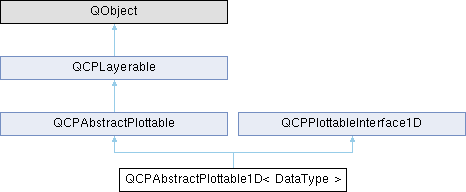
This template class derives from QCPAbstractPlottable and from the abstract interface QCPPlottableInterface1D. It serves as a base class for all one-dimensional data (i.e. data with one key dimension), such as QCPGraph and QCPCurve.
The template parameter DataType is the type of the data points of this plottable (e.g. QCPGraphData or QCPCurveData). The main purpose of this base class is to provide the member mDataContainer (a shared pointer to a QCPDataContainer<DataType>) and implement the according virtual methods of the QCPPlottableInterface1D, such that most subclassed plottables don't need to worry about this anymore.
Further, it provides a convenience method for retrieving selected/unselected data segments via getDataSegments. This is useful when subclasses implement their draw method and need to draw selected segments with a different pen/brush than unselected segments (also see QCPSelectionDecorator).
This class implements basic functionality of QCPAbstractPlottable::selectTest and QCPPlottableInterface1D::selectTestRect, assuming point-like data points, based on the 1D data interface. In spite of that, most plottable subclasses will want to reimplement those methods again, to provide a more accurate hit test based on their specific data visualization geometry.
Constructor & Destructor Documentation
◆ QCPAbstractPlottable1D()
| QCPAbstractPlottable1D< DataType >::QCPAbstractPlottable1D | ( | QCPAxis * | keyAxis, |
| QCPAxis * | valueAxis ) |
Forwards keyAxis and valueAxis to the QCPAbstractPlottable constructor and allocates the mDataContainer.
Member Function Documentation
◆ dataCount()
|
virtual |
Returns the number of data points of the plottable.
Implements QCPPlottableInterface1D.
◆ dataMainKey()
|
virtual |
Returns the main key of the data point at the given index.
What the main key is, is defined by the plottable's data type. See the QCPDataContainer DataType documentation for details about this naming convention.
Implements QCPPlottableInterface1D.
◆ dataMainValue()
|
virtual |
Returns the main value of the data point at the given index.
What the main value is, is defined by the plottable's data type. See the QCPDataContainer DataType documentation for details about this naming convention.
Implements QCPPlottableInterface1D.
◆ dataPixelPosition()
|
virtual |
Returns the pixel position on the widget surface at which the data point at the given index appears.
Usually this corresponds to the point of dataMainKey/ dataMainValue, in pixel coordinates. However, depending on the plottable, this might be a different apparent position than just a coord-to-pixel transform of those values. For example, QCPBars apparent data values can be shifted depending on their stacking, bar grouping or configured base value.
Implements QCPPlottableInterface1D.
Reimplemented in QCPBars.
◆ dataSortKey()
|
virtual |
Returns the sort key of the data point at the given index.
What the sort key is, is defined by the plottable's data type. See the QCPDataContainer DataType documentation for details about this naming convention.
Implements QCPPlottableInterface1D.
◆ dataValueRange()
|
virtual |
Returns the value range of the data point at the given index.
What the value range is, is defined by the plottable's data type. See the QCPDataContainer DataType documentation for details about this naming convention.
Implements QCPPlottableInterface1D.
◆ drawPolyline()
|
protected |
A helper method which draws a line with the passed painter, according to the pixel data in lineData. NaN points create gaps in the line, as expected from QCustomPlot's plottables (this is the main difference to QPainter's regular drawPolyline, which handles NaNs by lagging or crashing).
Further it uses a faster line drawing technique based on QCPPainter::drawLine rather than QPainter::drawPolyline if the configured QCustomPlot::setPlottingHints() and painter style allows.
◆ findBegin()
|
virtual |
Returns the index of the data point with a (sort-)key that is equal to, just below, or just above sortKey. If expandedRange is true, the data point just below sortKey will be considered, otherwise the one just above.
This can be used in conjunction with findEnd to iterate over data points within a given key range, including or excluding the bounding data points that are just beyond the specified range.
If expandedRange is true but there are no data points below sortKey, 0 is returned.
If the container is empty, returns 0 (in that case, findEnd will also return 0, so a loop using these methods will not iterate over the index 0).
- See also
- findEnd, QCPDataContainer::findBegin
Implements QCPPlottableInterface1D.
◆ findEnd()
|
virtual |
Returns the index one after the data point with a (sort-)key that is equal to, just above, or just below sortKey. If expandedRange is true, the data point just above sortKey will be considered, otherwise the one just below.
This can be used in conjunction with findBegin to iterate over data points within a given key range, including the bounding data points that are just below and above the specified range.
If expandedRange is true but there are no data points above sortKey, the index just above the highest data point is returned.
If the container is empty, returns 0.
- See also
- findBegin, QCPDataContainer::findEnd
Implements QCPPlottableInterface1D.
◆ getDataSegments()
|
protected |
Splits all data into selected and unselected segments and outputs them via selectedSegments and unselectedSegments, respectively.
This is useful when subclasses implement their draw method and need to draw selected segments with a different pen/brush than unselected segments (also see QCPSelectionDecorator).
- See also
- setSelection
◆ interface1D()
|
inlinevirtual |
Returns a QCPPlottableInterface1D pointer to this plottable, providing access to its 1D interface.
\seebaseclassmethod
Reimplemented from QCPAbstractPlottable.
◆ selectTest()
|
virtual |
Implements a point-selection algorithm assuming the data (accessed via the 1D data interface) is point-like. Most subclasses will want to reimplement this method again, to provide a more accurate hit test based on the true data visualization geometry.
If details is not 0, it will be set to a QCPDataSelection, describing the closest data point to pos.
\seebaseclassmethod
Implements QCPAbstractPlottable.
Reimplemented in QCPBars, QCPCurve, QCPFinancial, QCPGraph, and QCPStatisticalBox.
◆ selectTestRect()
|
virtual |
Implements a rect-selection algorithm assuming the data (accessed via the 1D data interface) is point-like. Most subclasses will want to reimplement this method again, to provide a more accurate hit test based on the true data visualization geometry.
\seebaseclassmethod
Implements QCPPlottableInterface1D.
Reimplemented in QCPBars, QCPFinancial, and QCPStatisticalBox.
◆ sortKeyIsMainKey()
|
virtual |
Returns whether the sort key (dataSortKey) is identical to the main key (dataMainKey).
What the sort and main keys are, is defined by the plottable's data type. See the QCPDataContainer DataType documentation for details about this naming convention.
Implements QCPPlottableInterface1D.
The documentation for this class was generated from the following file: